
Morrison County Court Record Requests
Start remotely with Minnesota Court Records Online, known as MCRO. Case Search opens the public Register of Actions for a Morrison County case. Document Search needs a full case number. Then it returns an available pleading, order, or judgment image. Hearing Search finds a setting. Judgment Search covers docketed money judgments. MCRO is free. Still, it is not the certified or official court record for a Morrison County case.
The wider Morrison County access chain also includes the public MPA, or MNPAC, terminal at the courthouse. It also includes the Court Administration counter and phone line, mailed copy requests, and eFS-related requests for parties. Transcripts go through a court reporter. The Morrison County public-record form works for administrative records. It cannot replace the Court Administration route for a court file. A good written request names the exact case, the document, the date range, and whether certification is needed.
- Identify the record: a Register of Actions, filed document, order, judgment, transcript, or county administrative record.
- Use the full case number when known. Morrison examples begin with 49, followed by a case-type code, year, and sequence.
- Check MCRO for eligible public case, document, hearing, or judgment information, then use the courthouse terminal if remote access is incomplete.
- For a copy, contact Morrison County District Court Court Administration in person or by phone, or mail the statewide request or a detailed letter with payment when required.
- Choose an ordinary, certified, exemplified, or transcript request and confirm the current charge and delivery method before paying.
Morrison County Court Record Custodian
Morrison County District Court Court Administration keeps the local District Court registers and case records. Minnesota sets no separate district-clerk and county-clerk split here. The office holds civil, family, probate, juvenile, criminal, traffic, conciliation, and related case types. County offices like the Recorder or Sheriff keep different records. Those are not court records.
Morrison County District Court Court Administration
213 First Avenue SE
Little Falls, MN 56345
320-412-7010
Weekday hours: 8:00 a.m. to 4:30 p.m.
When something goes sideways, the Morrison County counter is where you land. That includes a missing calendar entry, an older file, a certified copy, a restricted-record question, a terminal question, a balance issue, or a case number whose format makes no sense. The Judicial Branch access page notes that courthouse terminals are the more complete electronic layer. That applies to eligible District Court records. One limit applies. Court staff can walk you through a record search. But they cannot interpret the legal effect of an order or docket entry.
Kinds of Court Records
Court Administration keeps more than one product. The Register of Actions is the chronological case history. A judgment roll and a judgment docket serve different functions. A filed document can also sit apart from its register entry. Know the precise record you need before choosing a route. That choice decides whether a plain printout is enough.
- Registers of Actions, with the title of each action, filed-paper minutes, and proceedings.
- Filed pleadings, motions, notices, orders, and available document images.
- Judgment rolls and docketed judgment information, including recorded entry details.
- Hearing and calendar information, with date, time, location, officer, and setting type.
- Transcripts, which are separately prepared written records of a court proceeding.
The court-record statute lists what a court administrator keeps: the Register of Actions, judgment roll, judgment docket, indexes, and related records. The county's general data practices form has its place for county administration records. It is not a tool for bypassing the Judicial Branch process when you want a court file.
Morrison County Remote and Courthouse Records
MCRO, MPA or MNPAC, and the original court file overlap. But they are not the same thing. MCRO is the public remote application. MPA is the public view of the underlying Minnesota Court Information System. It is reachable at a courthouse terminal. That terminal can show eligible public material MCRO never publishes remotely. Treat any remote result as a convenience, not a certification that the file is complete or current.
| Access route | Best use | Important limit |
|---|---|---|
| MCRO | Free remote public Morrison County case, document, hearing, and judgment lookup | Not official or certified; older document access is limited |
| MPA/MNPAC terminal | More complete eligible electronic District Court view | Courthouse access; confirm local terminal availability |
| Court Administration | Public copy, certification, older material, and access questions | Offsite storage or restrictions can delay or limit a request |
Minnesota's copy-request overview draws a clear line between a free public MCRO document and an official copy obtained through the court.
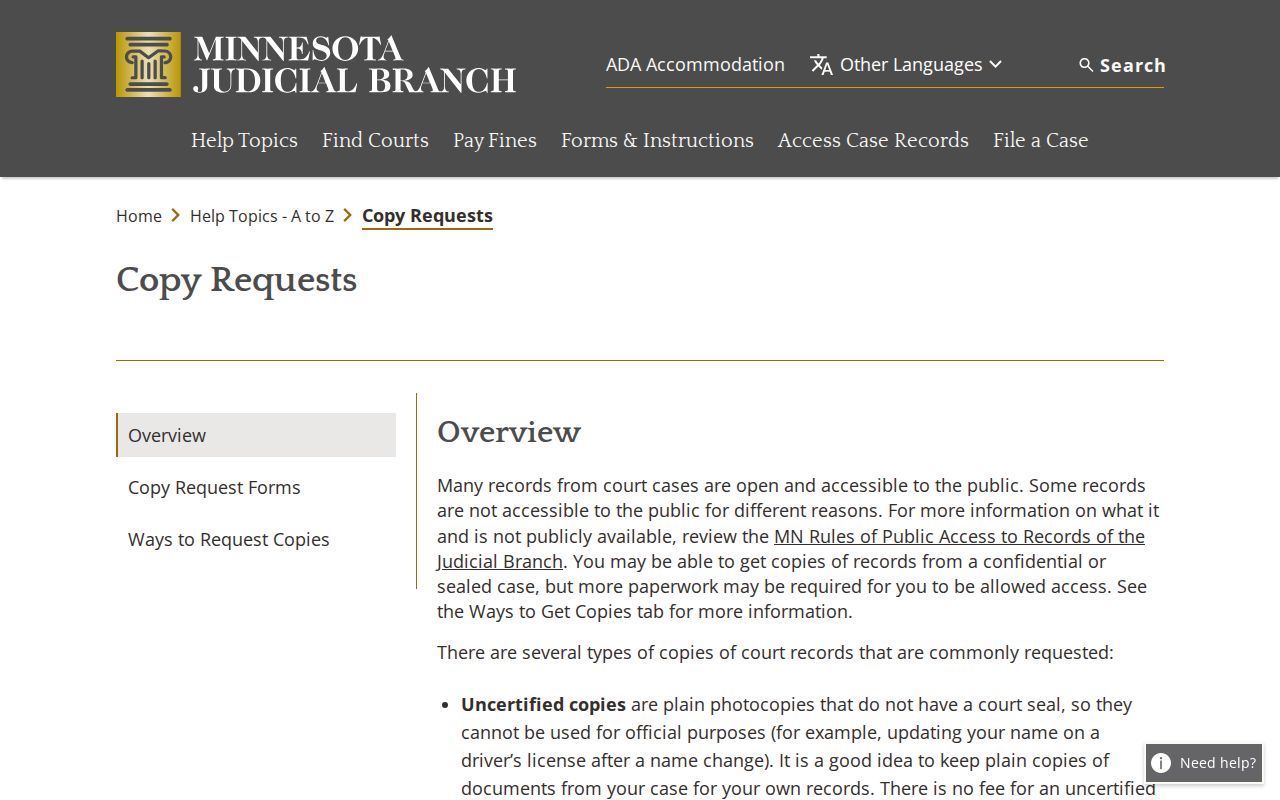
The official copy-request source repeats the point: a public online record and a certified Morrison County court record are different products. Many ordinary requests finish the same day. Offsite storage can delay delivery of older files.
Court Records: What They Contain
A Morrison County court file has a shape, and reading it in order helps. The header identifies the case. Party roles come next. Then comes the chronological Register of Actions, a hearing block, a judgment or disposition, financial entries, and a document index. Header, parties, register, hearing information, disposition or judgment, then financial data. That is the practical order. One caution applies. A filing, charge, motion, or hearing label is not the final recorded outcome by itself.
| Case number | Morrison County records commonly begin with location code 49; the next code identifies the case category. |
|---|---|
| Caption and roles | The formal case title and party roles, such as plaintiff, defendant, petitioner, or respondent. |
| Register of Actions | The dated sequence of filed papers, proceedings, hearings, notices, orders, and other permitted entries. |
| Hearing information | Location, date and time, judicial officer, hearing type, and connection or party role when entered. |
| Judgment or disposition | The recorded result or formal determination, which may need to be read with later entries. |
| Document index | Lists document entries; a listed index number does not guarantee a remotely available image. |
For a direct document lookup, MCRO Document Search demands the full state case number. A title ending in -Other may force you to open the document to learn its type. "Unknown pages" can mean an unreadable page count, not a missing document.
Morrison County Court Record Copy Routes
The best copy route depends on who is asking and for what. A public document visible in MCRO can be downloaded or printed at no charge. An in-person request can cover several things. Inspection, an ordinary copy, a certified copy, or a local paper file all qualify. A mailed request should include the case number. Add the document, the certification level, a delivery address, daytime contact, and payment as directed. Parties in an electronic case can use an eFS-related path. Non-parties should ask Court Administration for the proper public-copy route. The Judicial Branch ways-to-request-copies page lays out the in-person, mail, eFS, and confidential or sealed options.
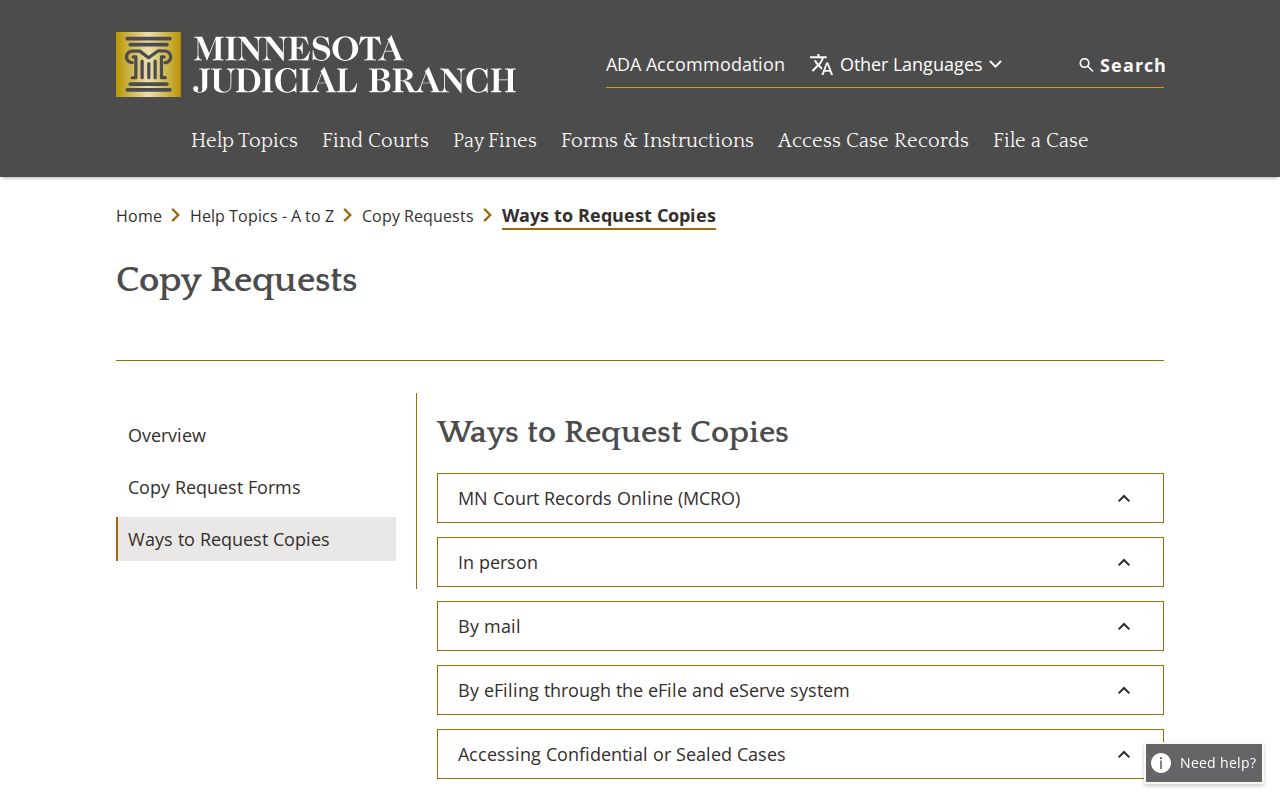
Sealed and confidential Morrison County court records sit behind extra steps. Expect a special form, proof of authority, or a judge's order. A standard county records form can still play a role here. It lets you list the record and choose how you want it delivered. It just cannot override a restriction the court has already placed on the file.
Note: Skip the Social Security number and financial-account number when emailing a general records request. Leave out other needless private details too.
Copy Fees and Certification
What kind of copy do you actually need? A plain screen print works fine for your own digging into a case. Official recipients usually demand more. Certification through Morrison County Court Administration authenticates the copy. An exemplified and certified copy adds yet another layer of authentication, while a transcript is a different product entirely, typed up by a court reporter. Ask which format your recipient requires before you order, so the request and the fee both fit the purpose.
| Morrison court-record item | Displayed fee |
|---|---|
| Uncertified copy, printout, or screen print | $0 for listed categories |
| Certified civil or criminal instrument | $14 |
| Exemplified and certified copy | $28 |
| Uncertified exemplified copy | $14 |
| Certified judgment search | $5 per name |
| Transcript of judgment | $40 |
Fees shift with format, page count, retrieval, and certification, so the final total can move. Check Morrison's district-court fee page for the current numbers before you order. It also lists separate charges for reports, scanning, faxing, and special work. Pay certified and exemplified copy fees by credit card. A check or money order made out to District Court Administrator also works.
Morrison County Court Record Transcripts
A Morrison County transcript is not the Register of Actions. It is a word-for-word record. It captures what happened in a court proceeding, typed by a court reporter. The request must be written and sent through that reporter. Include the hearing date and the proceeding type. Add a way to reach the court reporter, plus the judicial officer if you know it. Under the Minnesota transcript policy, you pay the reporter before preparation begins. Expedited rates are negotiable.
The posted Minnesota rate sheet sets $5.75 per page. That covers civil, family, probate, and related categories. Criminal and juvenile matters run $4.25 per page. The listed policy also identifies a $4.25 per-page indigent or IFP rate. Conciliation Court proceedings are not transcribed under the cited Rule 4 guidance. Confirm the reporter's current instructions and rate before quoting a final price.
Note: A transcript filed in MNCIS can carry its own public-access status. Ask Court Administration or the reporter about availability.
Access Rules for Court Records
A broad county records request is not what governs Morrison County court records. The Minnesota Rules of Public Access to Records of the Judicial Branch control them. Statutes aimed at specific record types apply too. Rule 8 draws the tiers. It covers remote access and inspection of registers, documents, calendars, and courthouse terminals. Rule 4 spells out which information is confidential and which records stay inaccessible. So one case can look different at the terminal, in a remote result, and in the original file. That is not a data error.
Minnesota court-record rules:
Rule 8 governs public inspection, copying, and remote access tiers for Judicial Branch records.
Rule 4 identifies nonpublic information, protected identifiers, and restricted case records.
Minn. Stat. § 485.07 describes Registers of Actions, judgment rolls, judgment dockets, and indexes kept by Court Administration.
Minn. Stat. § 609A can limit public access to expunged qualifying criminal records; Minn. Stat. § 260B.171 protects juvenile records.
Some files carry reduced or no public access at all. Juvenile records and commitment material fall in that group. Sealed or expunged files, protected addresses, and family party-submitted documents do too. A document index can also appear without an image. That may stem from a rule or an imaging limit. Ask Court Administration whether a public copy exists instead of assuming the document was destroyed.
Morrison County Federal Court Record Boundary
Not every case with a Morrison County tie belongs to Morrison County District Court. A federal case is a different animal. It lives in the United States District Court for the District of Minnesota. That court is a separate federal trial court. Federal public docket access runs through PACER. No state-court Register of Actions or local Court Administration request can hand you a federal docket. None can certify a federal case file either. For that, PACER is the official federal route for case information and docket entries.
The PACER site draws the federal boundary plainly. It is a separate records system, not another doorway into Morrison County District Court records. Ordinary remote federal access requires PACER registration. Its fee rules are posted on that official federal source. Take questions about the separate state-court file to Morrison County Court Administration.