
How the Morrison County Court Calendar Works
Morrison County District Court handles the county's major trial work as Minnesota's general-jurisdiction court. Through the Minnesota Judicial Branch, it posts a searchable daily calendar PDF. The PDF covers civil, family, probate, juvenile, criminal, traffic, and conciliation matters, within public-access limits. Think of it as today's plan. It is not a lasting archive of everything that ever happened. The case history behind any line lives in the Register of Actions at Minnesota Court Records Online. That site is known as MCRO.
Timing matters with this document. The court posts the PDF at 7:00 a.m. on business days. It refreshes the file hourly. Assignments shift during the day. The printed calendars outside courtrooms or in public lobbies can run newer than the online file. An absent entry does not prove a hearing was cancelled or moved. Read the calendar, the case register, and word from Morrison County District Court Court Administration together. Each answers a different question.
The Daily PDF Is an Operational Calendar
The official Morrison daily calendar PDF suits one job well. It shows what a courtroom is doing on a chosen day. Note the date on the file itself. Note when you checked it. Updates roll out during the day. Its public columns can show the party label, hearing location, date and time, judicial officer, and hearing type. They can also show the connection type and a Morrison case number starting with 49-.
The Little Falls calendar is the page behind the comparison that follows.
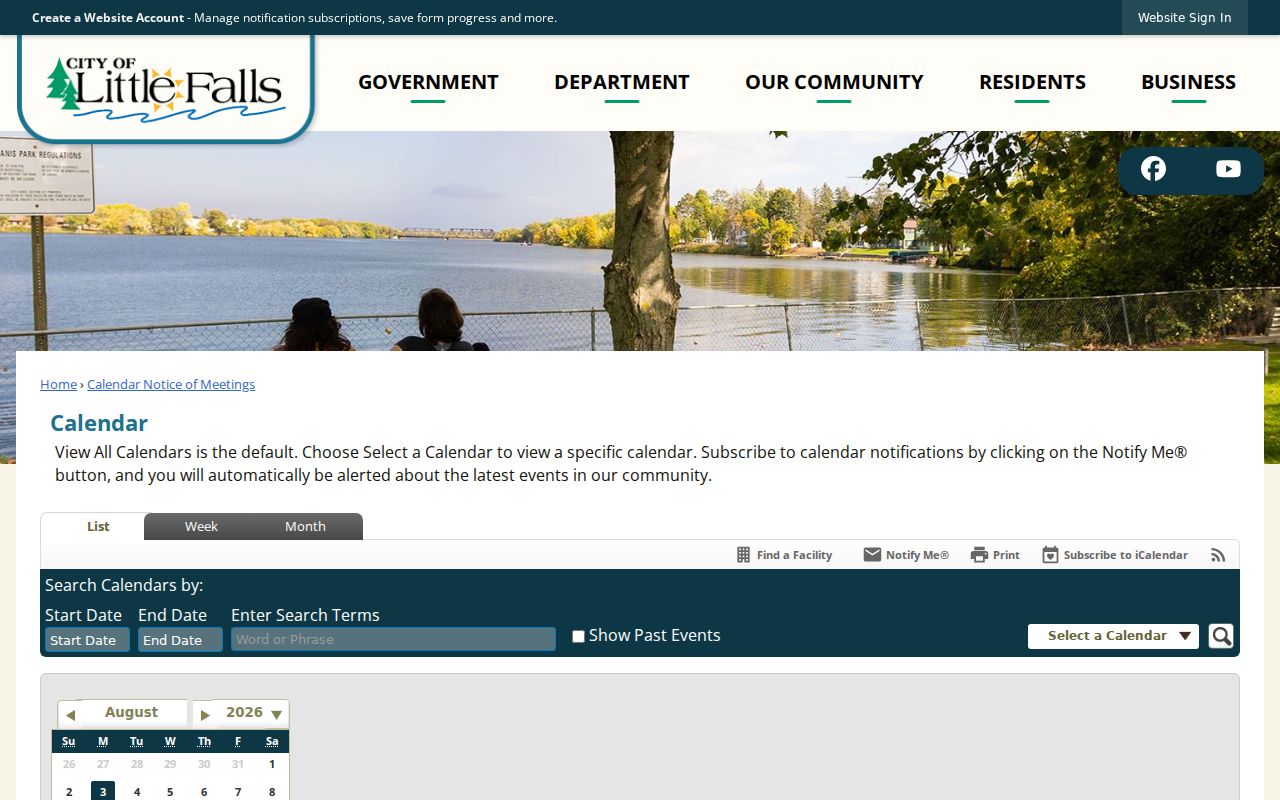
That Little Falls calendar belongs to the city, not to Morrison County District Court. The split matters. City events and court hearings never share a calendar. Even city police citations can become District Court cases later. For any District Court setting in Morrison County, rely on the Judicial Branch daily PDF.
Three Calendar Sources Answer Different Questions
Each calendar source answers a different question. The daily PDF shows what Morrison District Court has set for a given day. MCRO Hearing Search shows whether a hearing record matches a name, case number, judicial officer, attorney, date range, category, or county filter. The MCRO Case Search record then shows where that hearing sits. It places the hearing in the case's chronological Register of Actions. When the question is what the court decided, an order or judgment, if public, may be needed.
The courthouse public terminal helps when remote viewing does not settle a public-record question. It is called MNPAC or MPA Courthouse. Minnesota calls it a fuller electronic view than remote MCRO. The same access rules still apply to sealed and nonpublic material. Court Administration can point you to the terminal. It can also explain the local copy process. For the current setting, though, the daily calendar stays the operational source. It never replaces the case record.
Keep the retrieval date on any calendar note you make. MCRO's own terms warn that results can be incomplete or unreliable. A document index can exist without an image, and the interface can change. A newer PDF can supersede an older one without keeping the former setting. The working order is simple. Check the current calendar first. Get the hearing result second. Use the case register for context, and Court Administration when things do not line up.
Morrison County Court Date Lookups
A case number is the fastest way in. Morrison case numbers pair the county location code with a case-type code, like 49-CR-YY-NNNN for criminal cases or 49-CV-YY-NNNN for major civil cases. No number? MCRO Hearing Search accepts a name, judicial officer, or attorney, paired with a tight hearing-date range and Morrison chosen as the court location. One caution applies. A name result still needs a case-number check, since people share names.
- Open the current Morrison daily calendar PDF for the date in question and note its displayed date.
- Use MCRO Hearing Search with the case number first, or use a county-limited name, judicial-officer, or attorney search when the number is unknown.
- Open the matching case in MCRO Case Search and compare the hearing line with the chronological Register of Actions and any available public notice.
- Confirm the date, time, hearing location, hearing type, and judicial officer against the newest calendar. A party's attorney can also confirm the party's setting and any instructions supplied by the court.
- If the online sources conflict or the matter is absent, contact Morrison County District Court Court Administration at 320-412-7010. The staffed counter is at 213 First Avenue SE and is listed as open 8:00 a.m. to 4:30 p.m.; courtroom and lobby postings remain an additional same-day check.
MCRO Hearing Search Narrows the List
MCRO splits its work into Case Search, Document Search, Hearing Search, and Judgment Search. For a scheduled setting, Hearing Search is the focused tool. Its Name, Case Number, Judicial Officer, and Attorney tabs combine with an exact hearing date or date range. Category filters narrow things further. So does a Morrison location filter. Choosing Morrison over a statewide search cuts the unrelated noise. The hearing index can identify a date, time, location, officer, and type. It is neither a transcript nor an outcome report.
The official MCRO Hearing Search screen shows those search paths.
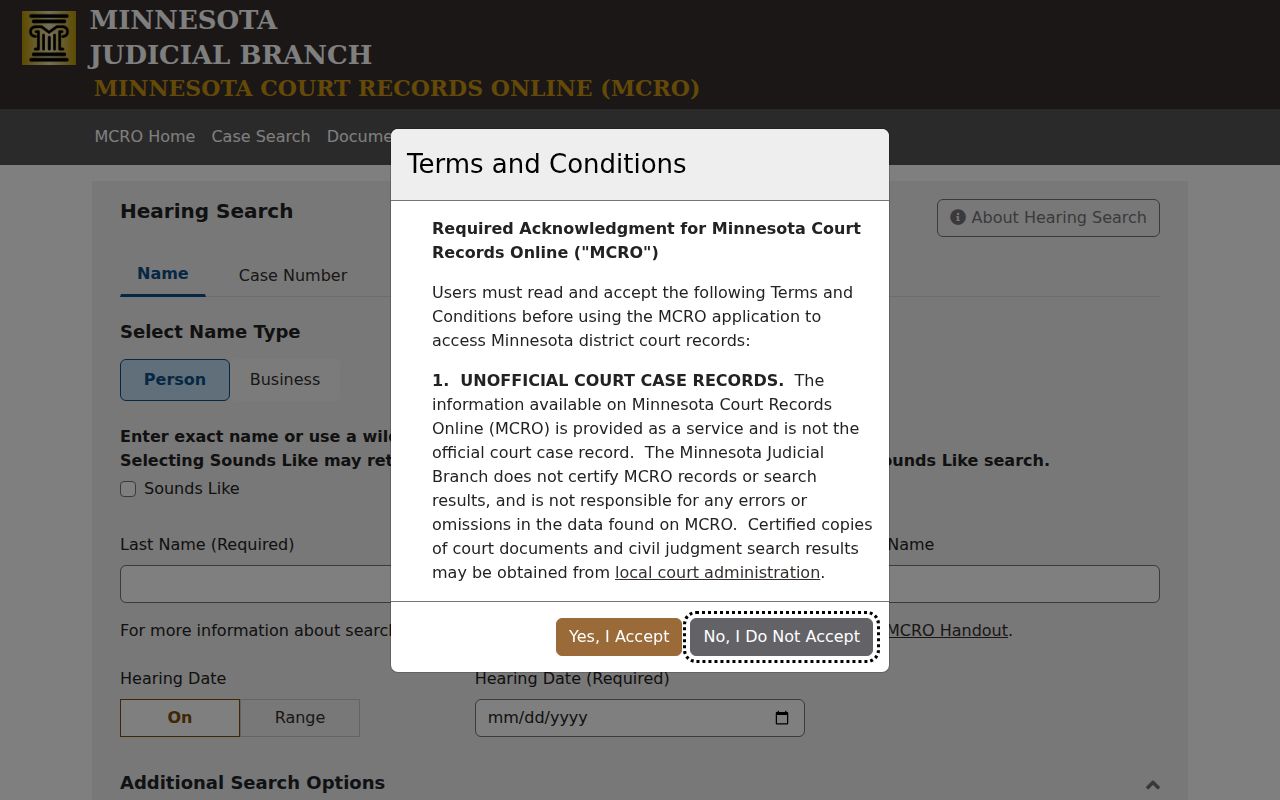
Treat the result as a locator, nothing more. Confirm it against the Register of Actions and the daily PDF. A hearing set for today may still display as upcoming in MCRO, so status wording alone is never a reason to skip a setting.
Court Settings: What Each Field Means
A calendar row tells you when and where. It never tells you who won. Whether a plea was entered, a motion was granted, or a case settled is simply not part of the setting. For that, turn to the case register's filing sequence, and to any public order or judgment that records the court's ruling.
| Party Name | The public-facing party label shown in the calendar. It should be matched to the case number rather than treated as identity verification. |
|---|---|
| Hearing Location | The listed courtroom or other setting, such as Court Room 1 or Court Room 2. Confirm it against the latest calendar. |
| Hearing Date Time | The scheduled date and time, not proof that the hearing was held. |
| Judicial Officer | The judge or other officer assigned on that calendar version. Assignments may change. |
| Hearing Type | The proceeding label, such as arraignment, pre-trial, motion hearing, sentencing, or status conference. |
| Connection Type | Connection or participant information appearing in the calendar. It is a clue about the setting, not a public remote-access credential. |
Labels Describe a Setting, Not Its Result
Morrison County calendars use labels such as arraignment, pre-trial, motion hearing, settlement conference, sentencing, status conference, court trial, probation violation hearing, and conciliation hearing. Each label only says what was scheduled. A settlement conference label does not prove anyone settled. A motion hearing entry does not reveal the ruling. A sentencing label does not state the sentence. Read the calendar for timing and place. Read the later Register of Actions, order, or judgment for what the court actually recorded.
A few other terms deserve care. "Continuance" or "reset" means the event moved to a later or different setting. "Notice of setting" marks a proceeding that was scheduled, nothing more. "Disposition" is the recorded resolution or procedural ending. No calendar label can supply it. "Connection Type" may name a participant or connection detail. It is neither an invitation code nor a promise of remote access. Keep these distinctions straight and a scheduling record stays what it is: a schedule, not a conclusion.
When a Court Date Moves
No Morrison-specific reset code list or fixed posting interval exists for every continuance. Compare the newest daily PDF with the Register of Actions and any notice the court issued. That combination is the dependable method. An older calendar line can still show the former setting, but treat it as history. After a continuance, cancellation, or reassignment, do not call that line the current court date.
Different dates across sources? Check the calendar's retrieval date and the full case number. Look for later events or notices in MCRO Case Search. The Morrison County District Court page lists Court Administration as the local contact. Reach out when a setting is inconsistent or missing. Skip the browser's Back button on MCRO results. The system's own terms tell users to rely on its navigation controls.
Remote-Hearing Details Need Confirmation
Minnesota's permanent district-court hearing framework took effect February 3, 2025. That does not make every Morrison County setting remote. Nor does a calendar connection field hand you a public video link. The Connection Type field may hint at how a matter is organized. The court itself supplies access instructions, accommodations information, and any limits for a given hearing. Ask Court Administration those case-specific questions. Do not assume an online calendar entry grants entry.
Whether you are a public observer or a party, keep two questions apart. One is whether a hearing appears on the calendar. The other is whether you can actually access it. A hearing can be listed with no access credential attached. A connection detail can shift with the setting. When you contact the court, give the case number and current calendar date. Do not email extra personal information.
Missed Settings and What Comes Next
A setting may have been missed, or you may only suspect it was. Act fast. Check the newest calendar and the Register of Actions. Then call the party's attorney or Morrison County District Court Court Administration for current status and instructions. The right next step depends on the case and on any order already entered. A blank on the calendar confirms nothing.
Do not wait on an old calendar. A missed court date can have serious case-specific consequences, including a warrant or bond-related action in an appropriate matter. Use the court or counsel to confirm the present setting promptly, and obtain legal advice about a missed appearance before acting on assumptions.